CIC Equipment Breakdown
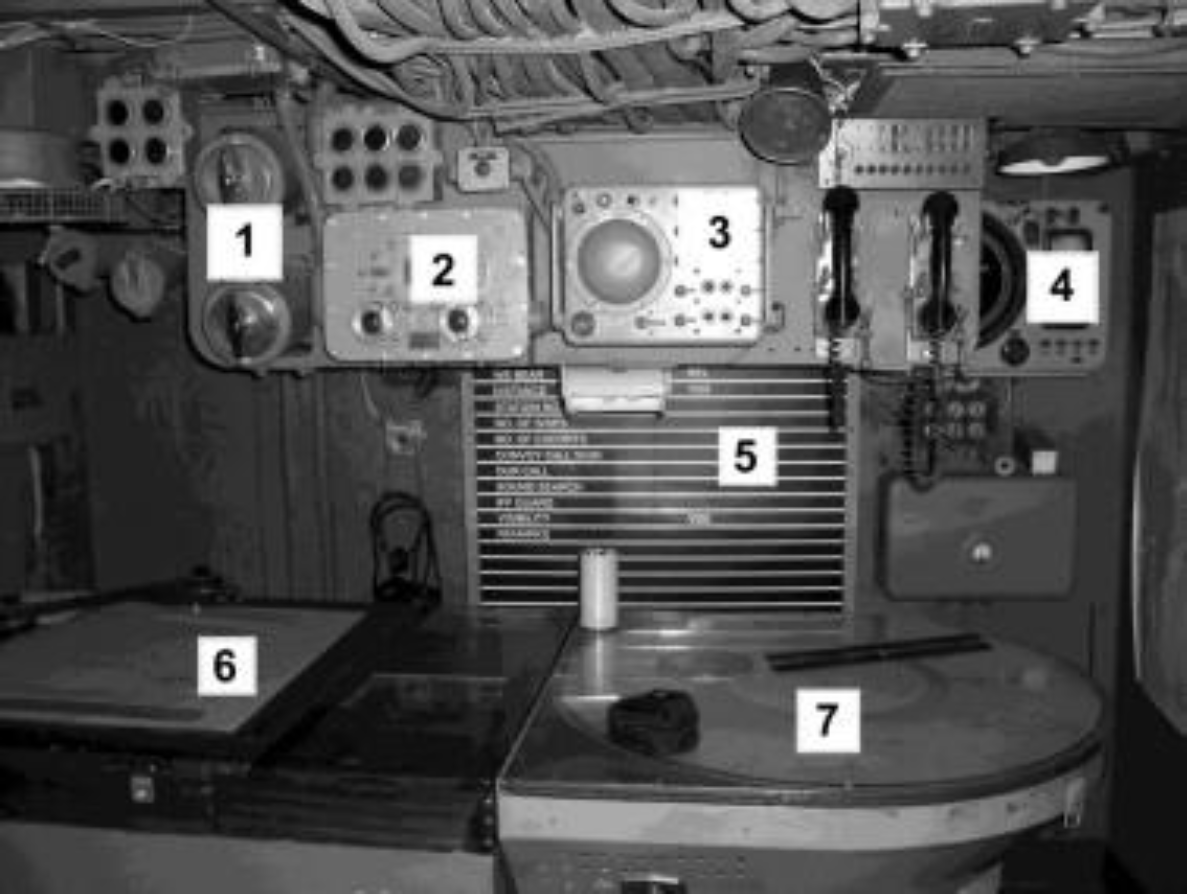
CIC, Forward Bulkhead
Radar Selector Switches: In World War II, there was a radar repeater on the flying bridge. It is currently located in the pilothouse to keep it out of the weather. The selector switches here enabled the repeater to display either the air or surface search radar, so the captain could see what was around the ship.
Target Designation Transmitter: This unit transmits range and bearing information to the 3”/50 Director. It allows CIC to put the gun director on the most important target.
21MC or Captain’s Command Intercom System: Pressing and releasing the third switch on the left column will play a recording of a sonar contact.
Fathometer: A navigational device used to measure and record the depth under the keel. It could also be used to determine the depth of a submarine if the ship runs over the top of it.
Status Board: Used to record pertinent information such as courses, station information, call signs, etc.
Dead Reckoning Tracer: The primitive WWII equivalent to GPS. The DRT was an electromechanical position keeper. Before getting underway, the current latitude and longitude would be entered. Once moving, the DRT would constantly update the ship’s latitude and longitude using inputs from the pitometer log (speed) and gyro compass repeater (course). However, it couldn’t compensate for wind or current, so the position given by the DRT was an estimate at best. The DRT was also used for tracking targets and for man-overboard situations.
Plotting Board: Used to plot positions of friendly and enemy contacts. Ordinarily, there would be two plots: one for surface contacts and one for air contacts.
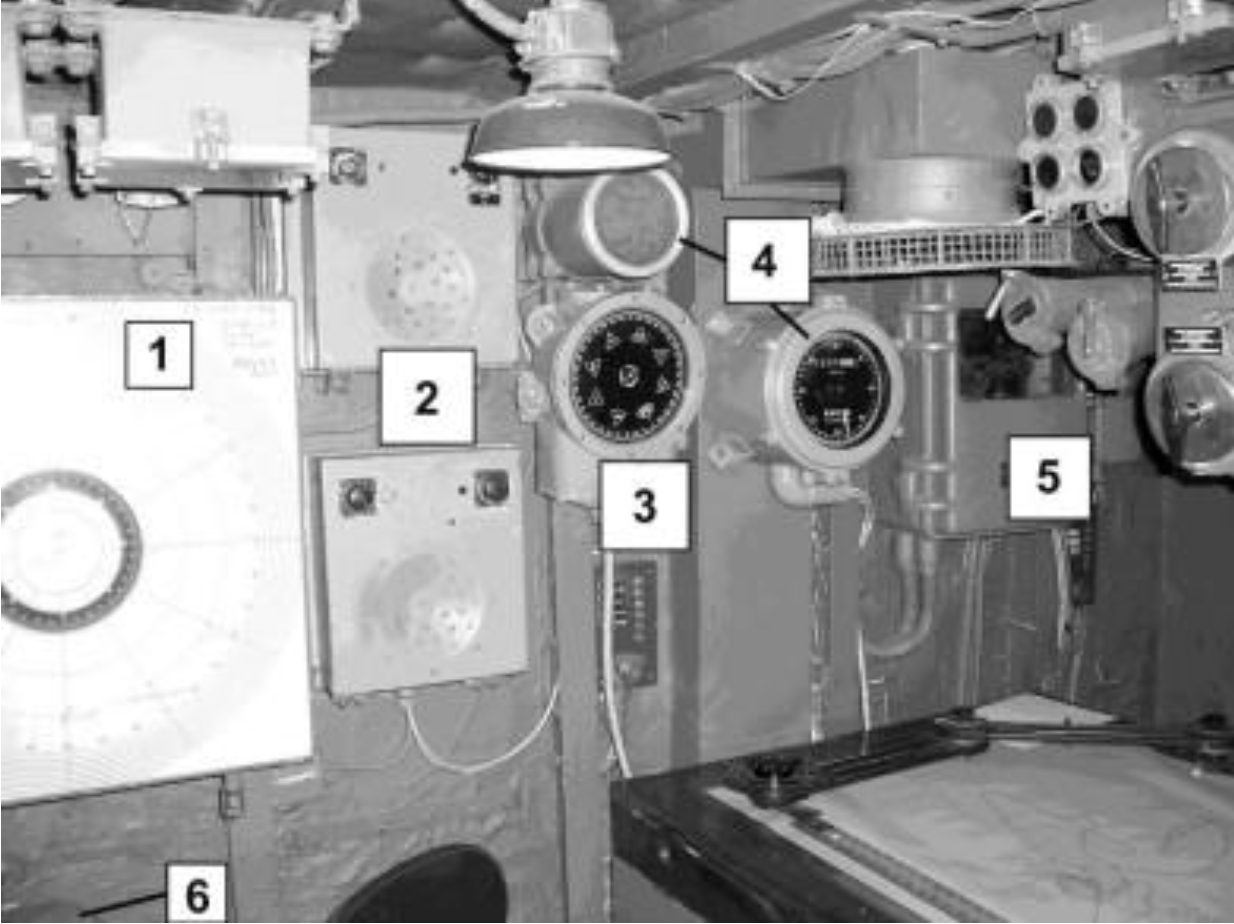
CIC, Portside
Plotting Board: A second plotting board.
Speaker Boxes: Used to monitor various radio frequencies. At least one of these should be playing a sonar ping.
Gyro Compass Repeater: Repeats the course provided by the master gyro beneath the crew’s mess. It is used by the DRT to generate the ship’s latitude and longitude.
Pitometer Log: Displays speed in knots. Used by the DRT to generate the ship’s latitude and longitude. There is a large pit log and a small pit log. The small pit log located above the gyro compass repeater is the original.
DRT Analyzer: This is the device that takes inputs from the gyroscope and pit logs to feed in latitude and longitude information into the DRT.
Identification Friend or Foe (IFF): The large gray box beneath the plotting board is the IFF. The IFF sent a signal out with the radar that, when it hit an Allied ship or plane, would cause a transceiver on the friendly unit to transmit a code back to the SLATER. The IFF would then pick up that code and display it on the radar scope. If the code was correct, you knew the target was friendly. If the code was incorrect, it required further investigation. If there was no code, you assumed the target was an enemy.
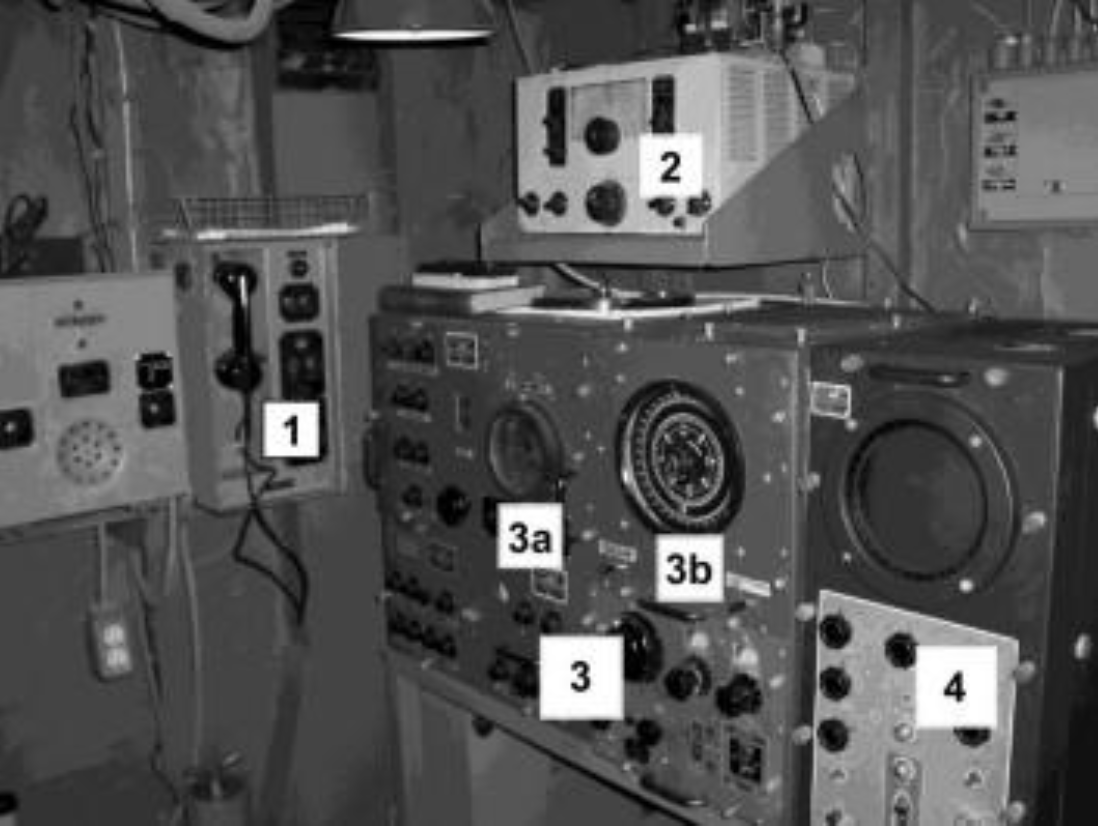
CIC, Air Search Radar
TBS Headset: This headset worked with the TBS radio to send and receive voice radio transmissions over a short distance.
Radio Receiver: Used to monitor local short-range radio traffic.
Air Search Radar (SA): The SLATER’s air search radar is a model SA. It could pick up both ships and aircraft. It could detect a large group of planes at 80 miles away, single large planes at 40 miles, small planes at 20 miles, battleships at 25 miles, a destroyer at 9 miles, a surfaced submarine at 2.5 miles, and land at 90 to 200 miles. When the SA was first introduced, it consisted of the large unit on the left (3a and 3b). The SA radar’s transmitter is located in the radio room.
3a is the AScope. One of the earliest radar scopes available. It could only display range. To determine bearing—the direction of the target—the operator had to use the bearing circle. 3b is the Bearing Circle. This consists of a gyro compass repeater inside a bearing circle. The inner wheel—the gyro repeater—turns with the ship. The outer ring—the bearing circle—remains fixed. The two diamonds in between represent the current position of the SA antenna. Thus, for an operator to use the early SA set, he had to look at the gyro repeater to get the ship’s direction, the diamonds to get the antenna’s current position, the outer ring to get the direction of the target, and the scope to get the range to the target. It was a cumbersome system. Later on, the Navy introduced the PPI.
Plan Position Indicator (PPI): This unit displays the same information as the A Scope and the Bearing Circle in one easy-to-use display. The ship is always in the center of the screen. When a pip—contact—appears, an operator can get the bearing by looking at the contact’s position relative to the center of the screen. The range is just as easy to determine. The farther away from the center of the screen the contact is, the farther away the ship is.
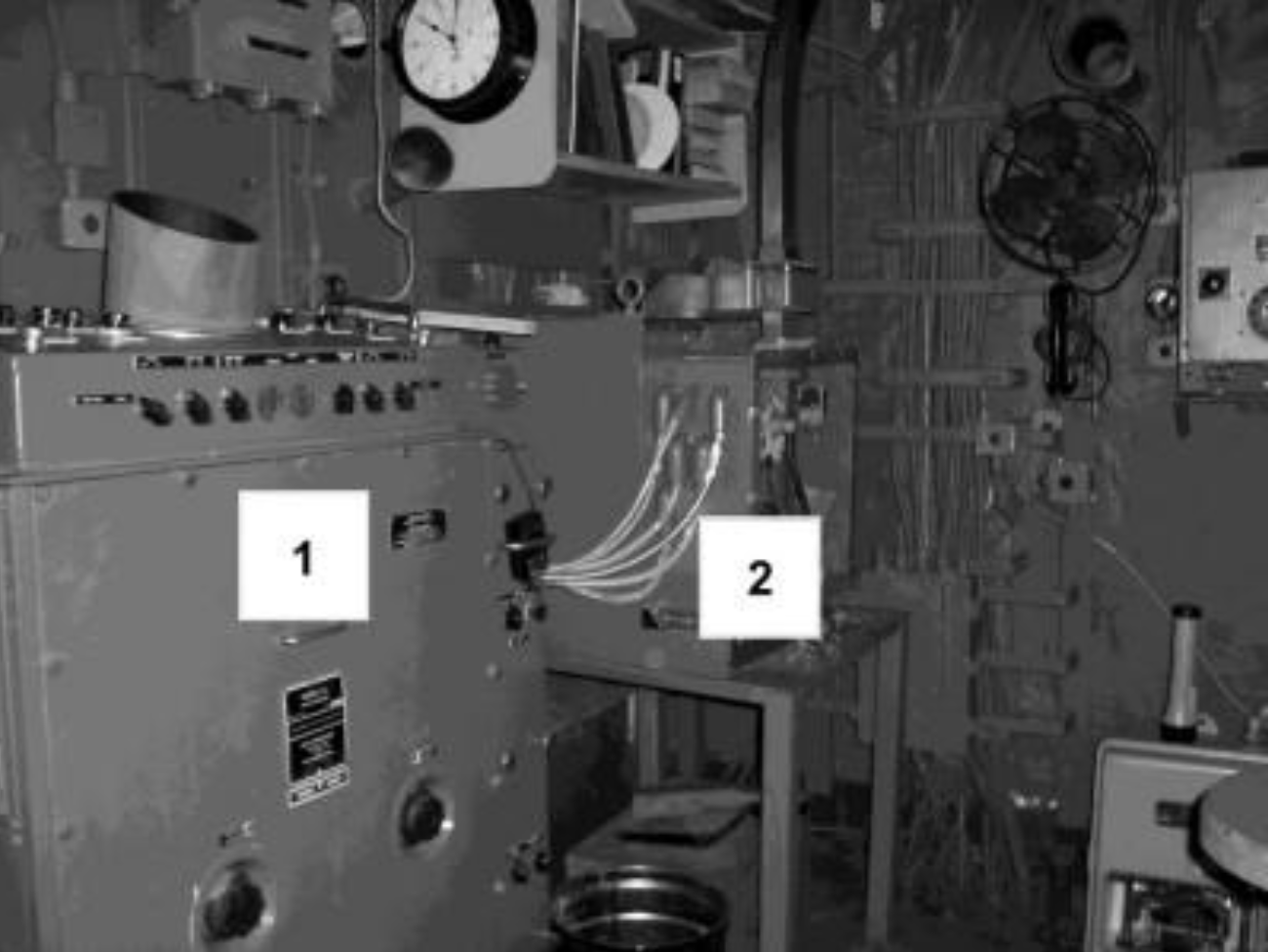
CIC, Surface Search Radar
SL Surface Search Radar: The SLATER’s surface search radar is a model SL. A later model than the SA set, the SL came with a PPI already installed. There is no A Scope or Bearing Circle with the SL Set. Like the SA set, the surface search radar could detect both ships and airplanes, but only if the planes were flying below 3,000 feet. The SL radar could detect a large ship at 23 miles, a small ship at 16 miles, a surfaced submarine at 8 miles, a periscope at 2 miles, buoys at 4 miles, and low-flying planes from 13 to 20 miles.
SL Transmitter: This device is what sends the radar signal to the antenna. The copper tube coming out of the top of the unit is the wave guide, which is used to carry the beam up the mast to the antenna. Currently, this is located in Radio Central.
High Frequency Direction Finder (Huff/Duff, HF/DF): Also on display here aboard SLATER, the Huff/Duff was developed to intercept German radio transmissions from U-boats. The equipment, originally developed by the British, played an important role in the detection and location of German submarines during the Battle of the Atlantic. Generally, an effort was made to fit at least one ship in every escort division with Huff/Duff. As originally built, SLATER was not fitted with Huff/Duff. However, because it was such a critical piece of destroyer escort history, when the opportunity came to acquire the unit, it was incorporated into the historical display.